


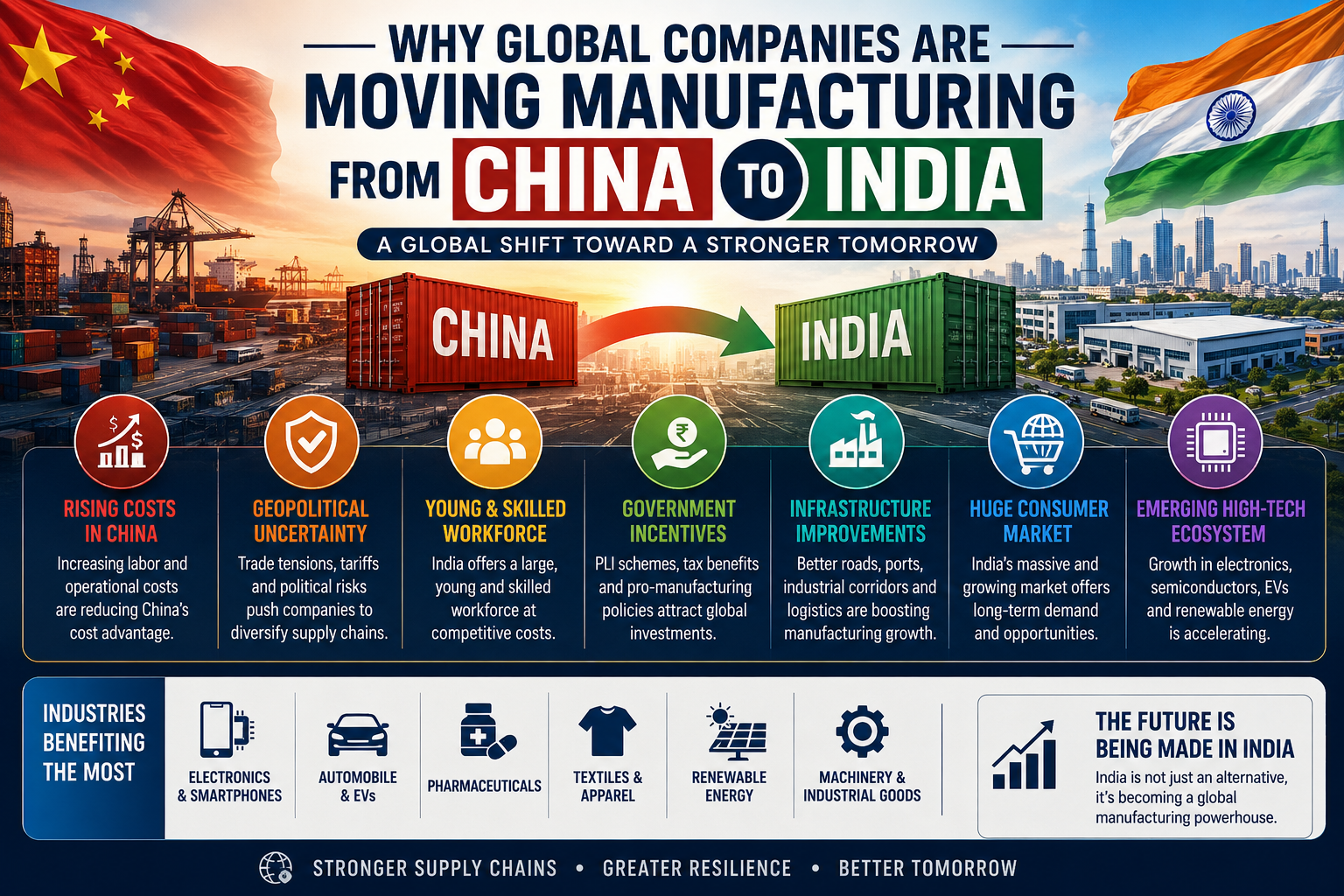
For decades, China was considered the undisputed global manufacturing hub. From electronics and automobiles to textiles and industrial goods, companies around the world relied heavily on Chinese factories for production. However, in recent years, a major shift has started taking place. Global corporations are now increasingly looking toward India as an alternative manufacturing destination.
The “China Plus One” strategy, geopolitical tensions, rising labor costs in China, and India’s growing economic reforms have accelerated this transition. In 2026, India is emerging as one of the strongest alternatives for global manufacturing investment.
But why exactly are companies shifting manufacturing from China to India? What industries are benefiting the most? And can India truly become the next manufacturing powerhouse?
Let’s understand the reasons behind this global shift.
The Rise of the “China Plus One” Strategy
The term “China Plus One” has become extremely popular among multinational corporations. This strategy means companies continue operating in China while expanding manufacturing operations to at least one additional country to reduce dependence on a single market.
The COVID-19 pandemic exposed serious weaknesses in global supply chains. When Chinese factories shut down during lockdowns, companies across the world faced shortages of products and raw materials. This made businesses realize the risks of relying too heavily on China.
As a result, corporations started searching for stable and cost-effective alternatives, and India quickly became one of the top choices.
Rising Labor Costs in China
China’s rapid economic growth has also increased wages significantly over the past decade. While higher wages benefit Chinese workers, they have made manufacturing more expensive for global companies.
India, on the other hand, offers a younger workforce and comparatively lower labor costs. With one of the largest working-age populations in the world, India provides businesses with access to millions of skilled and semi-skilled workers.
This labor advantage has become especially attractive for industries such as:
- Electronics manufacturing
- Textile production
- Mobile phone assembly
- Automobile manufacturing
- Consumer goods
For many businesses, manufacturing in India now offers better long-term cost efficiency.
Geopolitical Tensions and Trade Risks
Another major reason behind the manufacturing shift is growing geopolitical uncertainty.
The ongoing trade tensions between the United States and China have created concerns for multinational companies. Tariffs, export restrictions, and political disputes have increased operational risks for businesses dependent solely on China.
Many Western countries are now encouraging companies to diversify their supply chains away from China. India’s democratic structure, large consumer market, and improving global relationships make it an attractive alternative.
In addition, several governments are actively supporting investment partnerships with India in sectors like technology, semiconductors, defense, and clean energy.
India’s Government Incentives for Manufacturers
The Indian government has launched multiple initiatives to attract global manufacturing companies.
One of the most significant programs is the Production Linked Incentive (PLI) Scheme. Under this scheme, companies receive financial incentives for increasing manufacturing output within India.
The government has introduced PLI benefits for sectors including:
- Smartphones and electronics
- Semiconductors
- Pharmaceuticals
- Solar equipment
- Automobile components
- Telecom products
These incentives have encouraged companies to establish factories and expand operations in India.
The “Make in India” initiative has also improved investor confidence by promoting domestic manufacturing and reducing dependence on imports.
Apple’s Manufacturing Expansion in India
One of the biggest examples of this shift is Apple.
Over the last few years, Apple has significantly increased iPhone production in India through suppliers such as Foxconn, Pegatron, and Wistron. Several reports suggest that India could become a major global iPhone manufacturing hub in the coming years.
Apple’s expansion has had a ripple effect across the supply chain. Many component manufacturers and supporting industries are also investing in India to support production.
This has created new employment opportunities and strengthened India’s position in global electronics manufacturing.
India’s Massive Consumer Market
India is not only becoming a manufacturing base but also one of the world’s largest consumer markets.
With a population exceeding 1.4 billion people and a rapidly growing middle class, companies see India as both a production center and a major market for future growth.
Manufacturing products locally allows companies to:
- Reduce import costs
- Improve delivery speed
- Better understand local consumer preferences
- Expand market presence
This dual advantage makes India even more attractive compared to smaller manufacturing economies.
Infrastructure Improvements in India
For years, infrastructure challenges limited India’s manufacturing growth. However, major improvements are now changing the situation.
The government has invested heavily in:
- Highways and expressways
- Dedicated freight corridors
- Ports and logistics
- Industrial corridors
- Smart cities
- Renewable energy infrastructure
Projects like the Delhi-Mumbai Industrial Corridor are expected to significantly improve manufacturing efficiency and transportation networks.
Better infrastructure reduces operational costs and helps companies manage supply chains more effectively.
Growth of India’s Semiconductor Industry
Semiconductors have become one of the world’s most important industries. From smartphones and electric vehicles to AI systems and defense equipment, semiconductor demand is growing rapidly.
India is now actively trying to become part of the global semiconductor supply chain. The government has announced major investments and incentive packages to attract chip manufacturers.
Several international firms have already announced semiconductor and electronics-related investments in India.
If India succeeds in developing a strong semiconductor ecosystem, it could become a major competitor in the global technology manufacturing sector.
Challenges India Still Needs to Overcome
Despite the positive momentum, India still faces several challenges before it can fully compete with China’s manufacturing dominance.
Some key challenges include:
Bureaucratic Delays
Complex approval systems and regulatory processes can slow down investments.
Skill Development
India needs more advanced technical training programs to meet the demands of high-tech manufacturing.
Logistics Costs
Although infrastructure is improving, logistics costs in India remain higher than in some competing countries.
Land Acquisition
Industrial land acquisition can sometimes become a lengthy and complicated process.
However, many experts believe that continued reforms and investments could gradually address these issues over time.
Which Industries Will Benefit the Most?
Several sectors are expected to benefit significantly from the manufacturing shift toward India.
Electronics and Smartphones
India is already becoming a major mobile phone manufacturing hub.
Electric Vehicles (EVs)
Global EV companies are exploring India for battery and vehicle production.
Pharmaceuticals
India’s strong pharmaceutical industry continues to attract international partnerships.
Textiles and Apparel
India remains a strong alternative for global clothing brands seeking diversification.
Renewable Energy
Solar panel and green energy equipment manufacturing are expected to grow rapidly.
Can India Become the Next Global Manufacturing Hub?
India may not replace China completely anytime soon, but it is rapidly positioning itself as a major manufacturing alternative.
China still has enormous advantages in infrastructure, supply chain integration, and industrial scale. However, companies increasingly prefer diversification rather than dependence on a single country.
India’s combination of:
- large workforce,
- economic growth,
- government incentives,
- infrastructure development,
- and expanding consumer market
makes it one of the strongest manufacturing destinations for the future.
If reforms continue and investment momentum remains strong, India could become one of the world’s leading manufacturing economies over the next decade.
Final Thoughts
The global manufacturing landscape is undergoing a historic transformation. Companies are no longer relying solely on China and are actively expanding operations into other countries.
India has emerged as one of the biggest beneficiaries of this shift. With strong government support, rising foreign investment, and a growing industrial ecosystem, the country is steadily strengthening its role in global manufacturing.
While challenges remain, the opportunities are enormous. The coming years could define whether India successfully transforms itself into a true manufacturing powerhouse capable of competing on the global stage.
As multinational corporations continue diversifying their supply chains, India’s importance in the global economy is only expected to grow further.